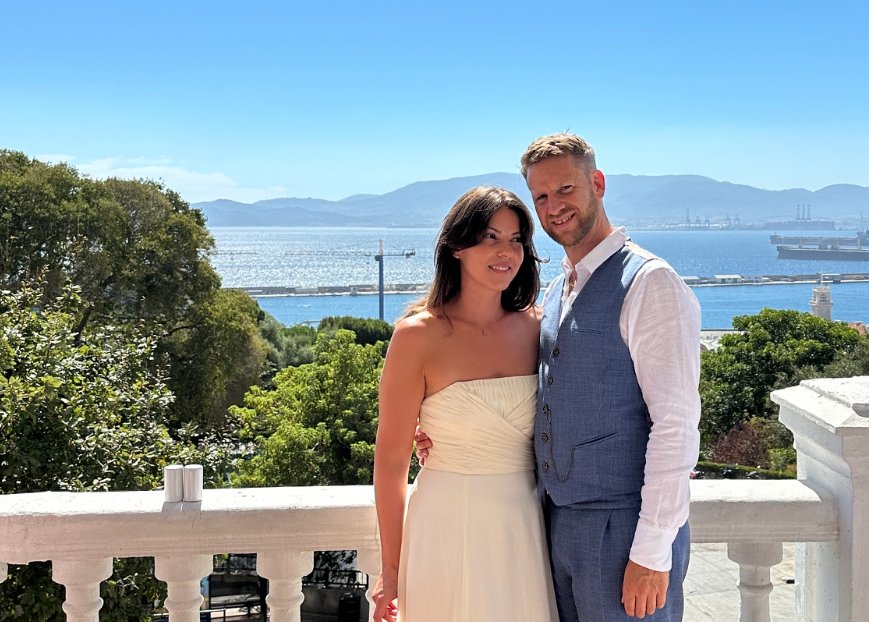
When we decided to get married, we wanted two things: to actually be married, and to skip the bureaucratic marathon that goes with it. I’m Romanian. My husband is British. We live together in Barcelona. On paper, our wedding was a three-country logistical nightmare waiting to happen.
So we went a fourth way. We got married in Gibraltar: start to finish, planned in just over a month, no fuss, no drama, and honestly some of the best money we’ve ever spent.
This is the article I wish I’d found when I started Googling “civil wedding ceremony” at 1am with a glass of wine and a tab full of consulate appointment pages. If you’re an international couple, a same-country couple who just wants something simple, or anyone trying to figure out how to plan a wedding in a month, pull up a chair.
| At a glance |
|---|
| Time to plan: roughly 30 days, start to finish |
| Total spend: ~£800–£900, all in |
| Where: Gibraltar City Hall ceremony, booked through an agency |
| Minimum stay: 1 night in Gibraltar before or after the ceremony |
| Witnesses: our family came along, so we didn't need any from the agency |
What Is a Civil Ceremony? (And How It’s Different from a Wedding)
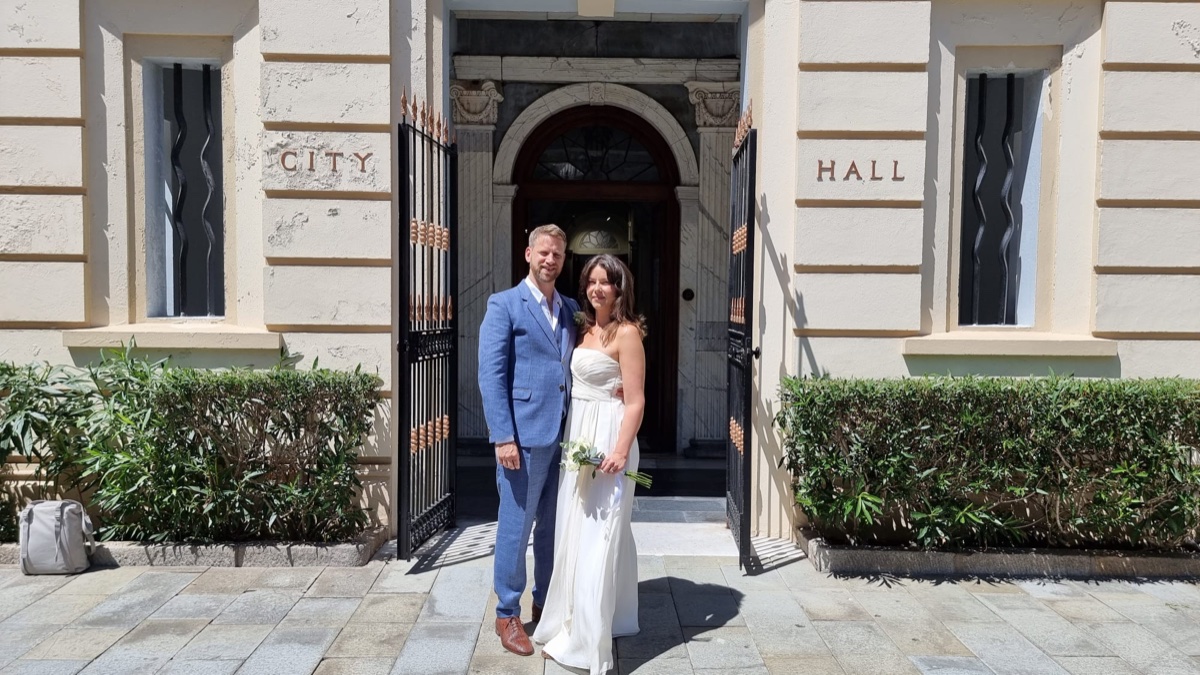
A civil ceremony is a legally binding marriage conducted by a government official rather than a religious leader. No church, no priest, no scripture. Just the legal act of becoming spouses in the eyes of the state. A civil wedding and a civil ceremony are the same thing; “wedding” is just the social, celebratory framing of what’s legally a civil ceremony.
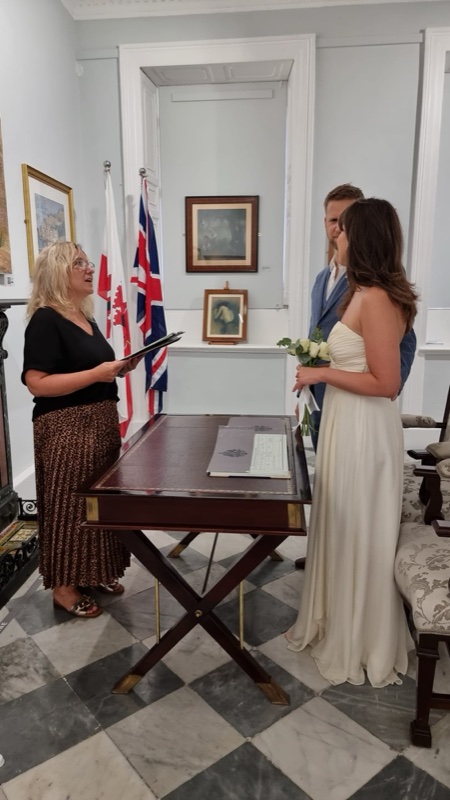
The actual ceremony itself is usually short (ours was around 15 minutes), conducted in a registry office, town hall, or another approved venue. You exchange vows, sign a register, and walk out legally married. It’s recognised internationally, and it’s what most couples around the world actually do, even when they have a separate religious or symbolic ceremony later.
The appeal of a civil wedding ceremony is exactly what it sounds like: it strips marriage back to the part that legally matters. You can absolutely add a party, a dress, photography, a dinner, but the ceremony itself is clean and fast.
Why We Skipped Spain, Romania, and the UK (And Chose Gibraltar Instead)
Here’s the thing nobody tells you about being an international couple: every country handles marriage differently, and every one of them has decided that their paperwork is the most important paperwork in the world.
When we started looking into our options, the picture was bleak:
- Spain (where we live): We’d need to gather apostilled birth certificates, certificates of no impediment, sworn translations into Spanish, residency proof, and then wait months for an appointment at the civil registry, if we could get one at all. Foreign nationals frequently report waits of 6–12 months.
- Romania (my country): A wedding there would mean flying back, dealing with my husband’s documents being translated and apostilled, and navigating in-person appointments at the local town hall.
- The UK (his country): He’d need to return, give 28 days’ notice in person at a register office, and we’d both need to be present for various steps. Add international travel and accommodation on top.
Each route involved weeks of document chasing, sworn translations costing hundreds of euros, in-person appointments, and a process that, if anything went wrong, would push everything back another two or three months.
Then we found out about Gibraltar.
Why Gibraltar? The “Las Vegas of Europe” (Without the Tackiness)
 Photo by Liisbet Luup via Pexels
Gibraltar has been a go-to destination for international weddings for decades. John Lennon and Yoko Ono famously married there in 1969. It’s a British Overseas Territory with its own civil registry, but it accepts couples from almost any nationality with minimal documentation and no residency requirement. You just need to be physically present for one night before or after the ceremony.
For us, the appeal was:
- One country to deal with, not three.
- English-speaking registry, no translations needed for our English-language documents.
- A short flight from Barcelona to Jerez de la Frontera, then a car the rest of the way.
- The whole thing handled by an agency, so we didn’t have to call any government office ourselves.
- Under £600 for the ceremony itself, with a luxurious 4-star hotel making the whole thing feel like a mini-honeymoon.
We used gibraltarmarriage.com (run by a company called Rock Prom). There are several similar agencies, like Sweet Gibraltar Weddings and a handful of others that all offer comparable packages. The model is the same: you send them scans of your documents, they liaise with the registry, book your slot, and tell you exactly when to show up.
That was it. We didn’t speak to a single government employee until we shook the registrar’s hand on the day.
How to Plan a Wedding in a Month: Our Real Timeline
People assume planning a wedding in a month is a stressful sprint. Ours genuinely wasn’t, but only because we made certain choices early. Here’s roughly how it went:
| Our four-week timeline |
|---|
| Week 1 — Decide and commit: chose Gibraltar, picked the agency, sent 2–3 preferred dates, uploaded scans of our documents (passports, long-form birth certificates with parents named, my husband's divorce papers). |
| Week 2 — Document approval and payment: the registry takes 5–10 working days to approve documents. Once approved, the agency confirms your date. We paid the invoice (€570 for the City Hall package) and booked the hotel. |
| Week 3 — Light logistics: outfits, ring sizing, dinner reservation. Witnesses sorted because our family came along, so we didn't need to arrange any through the agency. |
| Week 4 — Travel: flew to Jerez, drove the rest of the way down, signed affidavits the morning before the ceremony, got married the next day, headed home married. |
If you’re trying to figure out how to plan a wedding in a month, the trick isn’t to do everything faster. It’s to ruthlessly cut anything that isn’t legally required or genuinely meaningful to you. A destination civil ceremony forces that clarity. There’s no venue search, no caterer hunt, no seating chart, no save-the-dates. Just: the legal act, plus whatever celebration you choose to bolt onto it.
How to Organize a Civil Ceremony in Gibraltar: Step-by-Step
For anyone following our exact path, here’s how the civil ceremony wedding process actually works in Gibraltar:
1. Choose your agency and date
Send 2–3 preferred dates so the registry has flexibility. City Hall ceremonies run weekdays from 12:00 to 15:00 and are the most affordable option. Garden and yacht venues exist but cost significantly more.
Once your slot is provisionally booked, you’ll receive an invoice. Pay it within two working days or the slot is released. Invoices are available in GBP or EUR; the EUR conversion is usually slightly better than your bank would give you.
2. Submit your documents
You’ll need full-page, full-size scans or photos (no cropping, no background, the entire document visible) of:
| What you need to send |
|---|
| Both partners: passport and long-form birth certificate (the version that names your parents; short certificates won't be accepted). |
| If previously married: decree absolute or divorce certificate. |
| If you've ever changed your name: deed poll. |
| If widowed: death certificate of the former spouse. |
All documents must be in English. If yours aren’t, the agency can arrange certified translation for around £160 / €195. The originals, with wet ink seals and signatures, never laminated, must be brought in person on the day you sign the affidavits. Photocopies will be refused.
One nuance worth flagging if you’re divorced: in some countries (Spain included), divorce papers are now issued as digitally signed PDFs rather than physically stamped documents. These are generally accepted by the Gibraltar registry as long as the barcode is readable and the document is verifiable online, but confirm with your agency in advance and bring a clean printout. If you can get a court stamp on top of that, even better.
3. Book accommodation
You must spend at least one night in Gibraltar immediately before or after the ceremony, and provide a “Proof of Stay” letter from your accommodation. Agencies usually have preferential rates at hotels like the Eliott (4-star) or Sunborn (the 5-star yacht hotel). We ended up booking the Eliott because the rates were slightly better, which worked fine, but if you go via Airbnb, make absolutely sure the host can provide a Proof of Stay on letterhead. Otherwise the registry won’t accept it.
4. Sign the affidavits
Arrive in Gibraltar the day before. At 9am the morning before the ceremony, you’ll go to the Registry at 3 Secretary’s Lane, present your originals, and sign sworn affidavits. The agency prepares these for you in advance. They just need your professions, residential address, and your fathers’ full names and last professions. It takes maybe 30 minutes.
5. Get married
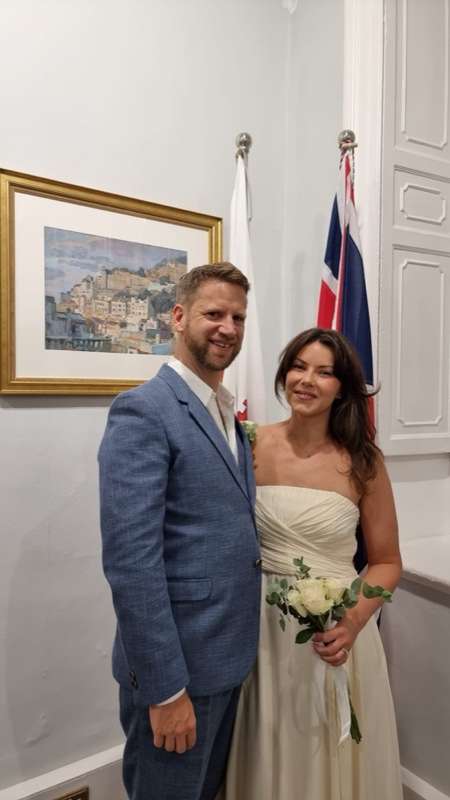
Show up at City Hall at your scheduled time (ours was 1:30pm on a Tuesday). The registrar reads the legal form, you exchange vows and rings, you sign, your witnesses sign, and you’re married. The ceremony itself lasts about 15 minutes. Photography is included as part of the package, but only if you’ve ordered witnesses through the agency. If you bring your own witnesses, you’ll need to arrange your own photographer.
6. Receive your certificate
You leave with one marriage certificate. If you need extras for changing your name across multiple countries (and you probably will), order additional copies with apostille upfront. They’re £23 each plus £17 per apostille. Cheaper to order more than you think you need than to request them later from abroad.
How Much Does a Civil Wedding in Gibraltar Cost?
Real numbers from our experience in 2024:
| Our 2024 spend |
|---|
| City Hall ceremony package: £520 — registry fees, Commissioner for Oaths, one marriage certificate, postage, photography if witnesses are ordered, marriage licence. |
| Hotel (1 night, Eliott 4-star, booked separately): ~£180 |
| Tourist tax: £3 per person per night |
| Extra marriage certificates with apostille (recommended): ~£40 each |
| Fuel and food en route: ~€150 |
| Total: roughly £800–£900, all in |
If you want something fancier in Gibraltar, ceremonies in the Alameda Botanic Gardens, the Garrison Library, or on Top of the Rock range from roughly £1,000 to £1,500, still a fraction of a traditional wedding.
Attire for a Civil Ceremony: What to Wear
The dress code for a civil wedding ceremony is entirely up to you. There’s no religious framework dictating what’s “appropriate.” Most couples opt for something dressy but not over-the-top. I wore a simple white midi dress; my husband wore a linen suit without a tie. Photos came out beautifully, and we didn’t feel like we were playing dress-up in a registry office.
Simple Civil Wedding Dress Ideas
When I was searching for a simple civil wedding dress, these were the styles that came up again and again, and the ones that I think actually photograph best in a small, intimate ceremony setting:
Midi-length slip dress
In white, ivory, or champagne silk.


Tailored mini dress
With structured shoulders, great for city hall settings.


Two-piece suit
In cream or pale blue — an increasingly popular choice.


Jumpsuit
In white or off-white. Modern, comfortable, and surprisingly photogenic.


Embroidered cotton or linen dress
For a relaxed, summer-ceremony feel.


The key with a civil wedding dress is to lean into the scale of the event. A cathedral-train ballgown in a small registry office feels mismatched; a beautifully cut midi dress feels exactly right. Comfortable shoes matter, you’ll likely be walking to lunch, to a photo location, to a bar afterwards. Save the heels for the dinner.
For grooms (or the second half of any couple), think well-cut suit, no tie or a soft knit tie, and shoes you can actually walk in. The whole vibe is “elevated daytime,” not “black-tie gala.”
Frequently Asked Questions About Civil Wedding Ceremonies
What is a civil ceremony vs. a civil wedding?
They’re the same thing. “Civil ceremony” emphasises the legal act; “civil wedding” emphasises the celebratory framing. Both refer to a legally binding marriage conducted by a government official rather than a religious figure.
How long does a civil ceremony take?
The legal ceremony itself usually takes 10–20 minutes. Ours was about 15 minutes from “please rise” to “you may kiss the bride.” The whole visit to City Hall, including signing and photos, took about 45 minutes.
Do you need witnesses for a civil wedding?
Yes. In most jurisdictions, including Gibraltar, you need two witnesses. They can be friends or family, but if you’re travelling alone, agencies can provide official witnesses (usually around £50 for two).
Is a civil wedding in Gibraltar legally recognised elsewhere?
Yes. A Gibraltar marriage certificate is recognised internationally. To register it in your home country, you’ll usually need an apostille on the certificate. Order these at the time of the ceremony to save hassle later. We registered ours in Spain, the UK, and Romania with no issues.
Can same-sex couples have a civil wedding in Gibraltar?
Yes. Gibraltar legalised same-sex marriage in 2016 and the process is identical to opposite-sex marriages.
Do I need to be a Gibraltar resident to get married there?
No. You just need to physically spend at least one night in Gibraltar before or after the ceremony and provide a “Proof of Stay” document from your accommodation.
How far in advance should I book?
Realistically, 6–8 weeks is comfortable. We did it in about 10 weeks but could have done it in 4–5 if needed. The bottleneck is the 5–10 working days for the registry to approve documents, plus translation time if your documents aren’t in English.
What if my partner is divorced?
You’ll need the original divorce decree absolute (or equivalent), with wet ink seal and signature. Increasingly, courts (including in Spain) issue divorce papers as digitally signed PDFs rather than physically stamped documents. These are generally accepted as long as the barcode is readable and the document is verifiable online. Bring a clean printout and, if possible, a court or government stamp on top. Check with your agency well in advance so there are no surprises.
Can I have a religious ceremony later?
Absolutely. Many couples have a civil wedding for the legal paperwork, then a separate religious or symbolic ceremony for family and tradition. They’re not mutually exclusive.
Was It Really the Best Decision? Yes.
We’ve now been married long enough to look back at the choice clearly, and neither of us has a single regret about how we did it. The day itself was intimate, warm, and memorable in exactly the way a wedding should be. We weren’t exhausted. We weren’t broke. We didn’t spend a year of our lives navigating three countries’ civil registries.
If you’re an international couple, a couple short on time, or just a couple who doesn’t see the point in turning a marriage into a year-long production, a civil wedding ceremony abroad, and specifically in Gibraltar, is genuinely one of the most practical, beautiful, low-stress ways to do it.
We saved the celebration for later, surrounded by the people we love. But the marriage itself? That happened on a sunny Tuesday in August, in a small room in Gibraltar’s City Hall, in about 15 minutes flat. And it was perfect.
If you’re planning your own civil ceremony and want to keep the celebration side just as simple, Posy is a wedding photo sharing app: one QR code, every guest’s photos in one private gallery, no app for them to install. Take a look. We built it for couples like us.